
Trenton, NJ · Garage Door Service
Garage Door Service for Trenton's Older Housing Stock
Garage door service for Trenton homes built mostly in the 1960s and 70s, where original hardware and cold winters wear springs and tracks fast.
- Repairs & new doors
- Springs & openers
- Serving 7 nearby communities
Why This Fails Locally
Trenton's housing runs from 1938 up through 2004, but the bulk of it - across the 57 named neighborhoods and nearby areas we see jobs in - went up in the 1960s and 70s. That matters for garage doors because a door installed or last serviced during that build wave is now 50 to 60 years into a steel track, torsion spring, and cable system that was never designed to run that long. Springs are rated in cycles, not years, and a door original to a 1968-built house has usually gone through two or three times the cycles its hardware was rated for.
Add the climate band here - cold and severe winters with real freeze-thaw swings - and you get a second failure mechanism on top of age: metal contracts in the cold, lubricant thickens or dries out, and tracks that were bolted true in 1968 have shifted slightly with decades of frost heave under the slab. On a newer door in a mild climate, a stiff spring just squeaks. On a 55-year-old door in Trenton's winters, that same stiffness is what snaps a cable or splits a panel seam.
This isn't a defect in any one door. It's what happens when original-era hardware meets a climate that's hard on metal, year after year, without anyone touching it in between.
How It Shows Up
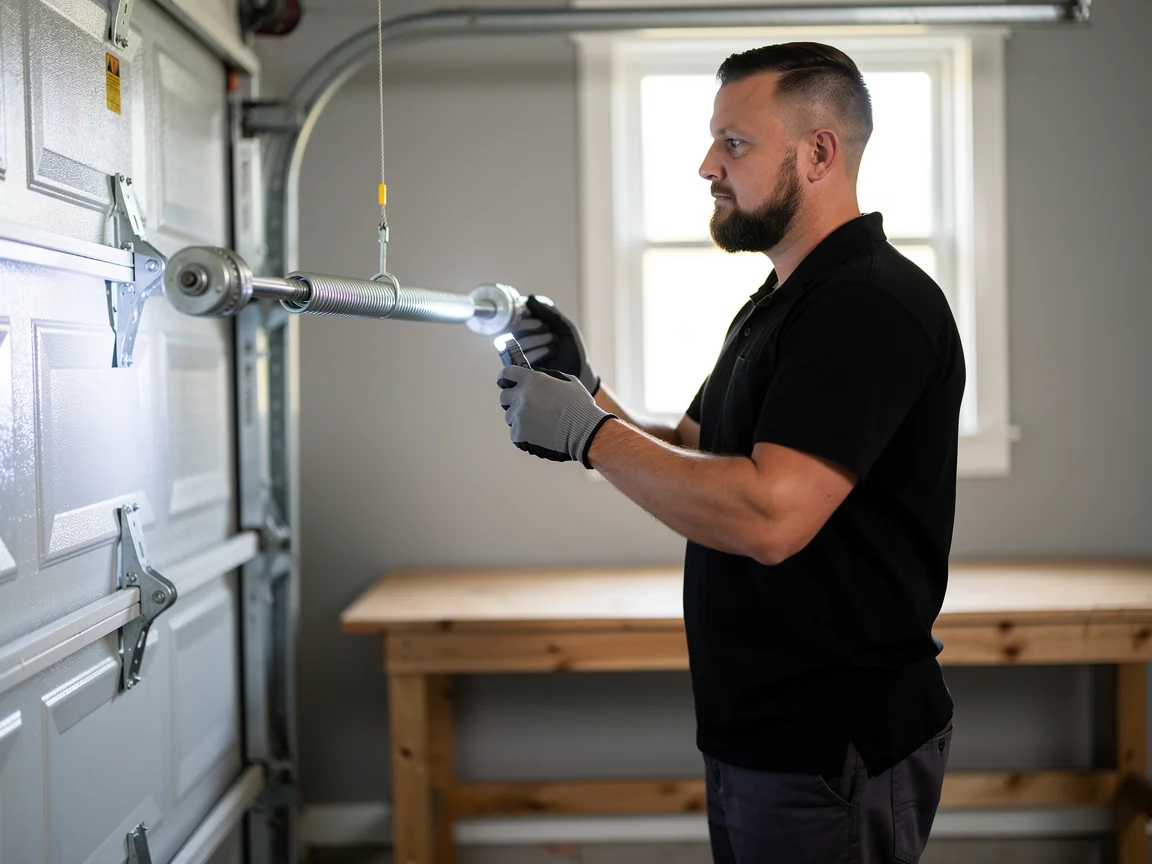
The most common call we get from the older sections of Trenton is a door that's suddenly heavy to lift by hand or won't open past a few inches with the opener - that's a torsion spring that's lost tension or broken outright, and on a house from the 1960s-70s wave it's often the original spring, never replaced. Close behind that: a door that shudders, drags on one side, or comes off track slightly when it closes, which points to rollers and track brackets that have loosened or corroded over decades of cold cycling.
You'll also hear it before you see it. A grinding or popping noise on opening, especially in the first cold snap of the season, usually means metal that's stiffened up and is binding against a track that's drifted a fraction out of alignment. None of these are urgent emergencies the first time they happen, but in cold weather a strained spring or a binding roller tends to fail completely within a few uses, not gradually.
If your door is original to a house built in that 1938-2004 range and nobody's serviced the spring or hardware since, these symptoms aren't random - they're the predictable end of that hardware's working life, pushed along faster by winters here.
What the Fix Involves
For most of these calls, the job is spring and hardware replacement, not a new door. We pull the old torsion spring, cables, and worn rollers, check the track for the kind of drift that comes from decades of freeze-thaw movement under the slab, and reset or replace brackets that have loosened. On a door that's structurally sound - most steel doors from this era still are - that's a service call, not a remodel.
Where it isn't worth fixing: if the panels themselves have rusted through or the door was never insulated and you're trying to match it to a newer, tighter garage, replacing the spring and hardware won't solve that. We'll tell you straight if your door's hardware is salvageable but the door itself has reached the end of its run - we'd rather say that up front than have you pay twice.
One limitation worth knowing: spring sizing has to match the door's weight and the drum size on the shaft exactly. On older doors where the track or opener has been swapped at some point without matching parts, this sometimes takes an extra visit to source the right spring rather than something we carry on the truck for every job.
How to Book
If your door's hardware dates back to the original build of your house - common across the 1960s-70s housing here - the spring and rollers are worth a look before they fail outright in cold weather. Reach out through our site and describe what the door's doing: heavy to lift, grinding, off-track, or dead on the spring. That tells us what to bring the first time instead of making you wait on a second trip. Get in touch.
Frequently asked questions
Why did my garage door spring break in the middle of winter?
Cold makes metal more brittle and stiffens the lubricant on the spring and track, which adds strain right at the point in the cycle count where an older spring is already weakest. If your house dates to the 1960s or 70s and the spring's never been replaced, winter is often when decades of wear finally catch up.
Is it normal for an older garage door to need new hardware, not a new door?
Yes. Most doors from Trenton's main building era, the 1960s and 70s, still have sound steel panels even after the spring, cables, and rollers wear out. Replacing hardware on a structurally sound door is standard and usually cheaper than full replacement.
How do I know if my door's hardware is original to the house?
If you've owned the house since it was built or bought it without any garage door paperwork, and the spring looks rusted or the opener is an older chain-drive unit, it's likely original. A technician can confirm cycle wear and age by looking at the spring and track hardware directly.
By Neighborhood
Garage Door Service across the Trenton area
We also handle garage door service in these Trenton-area suburbs.
Book garage door service in Trenton
Call now or request a quote - tell us what the door is doing and where you are.