
Trenton, NJ · Garage Door Service
Roller Replacement for Montgomery's 1990s-Era Garage Doors
Montgomery's garage doors date mostly to the 1990s, not the 1960s stock seen elsewhere in the area. Here's what that means for roller wear and replacement.
- Repairs & new doors
- Springs & openers
- Serving 7 nearby communities
What Is on the Truck
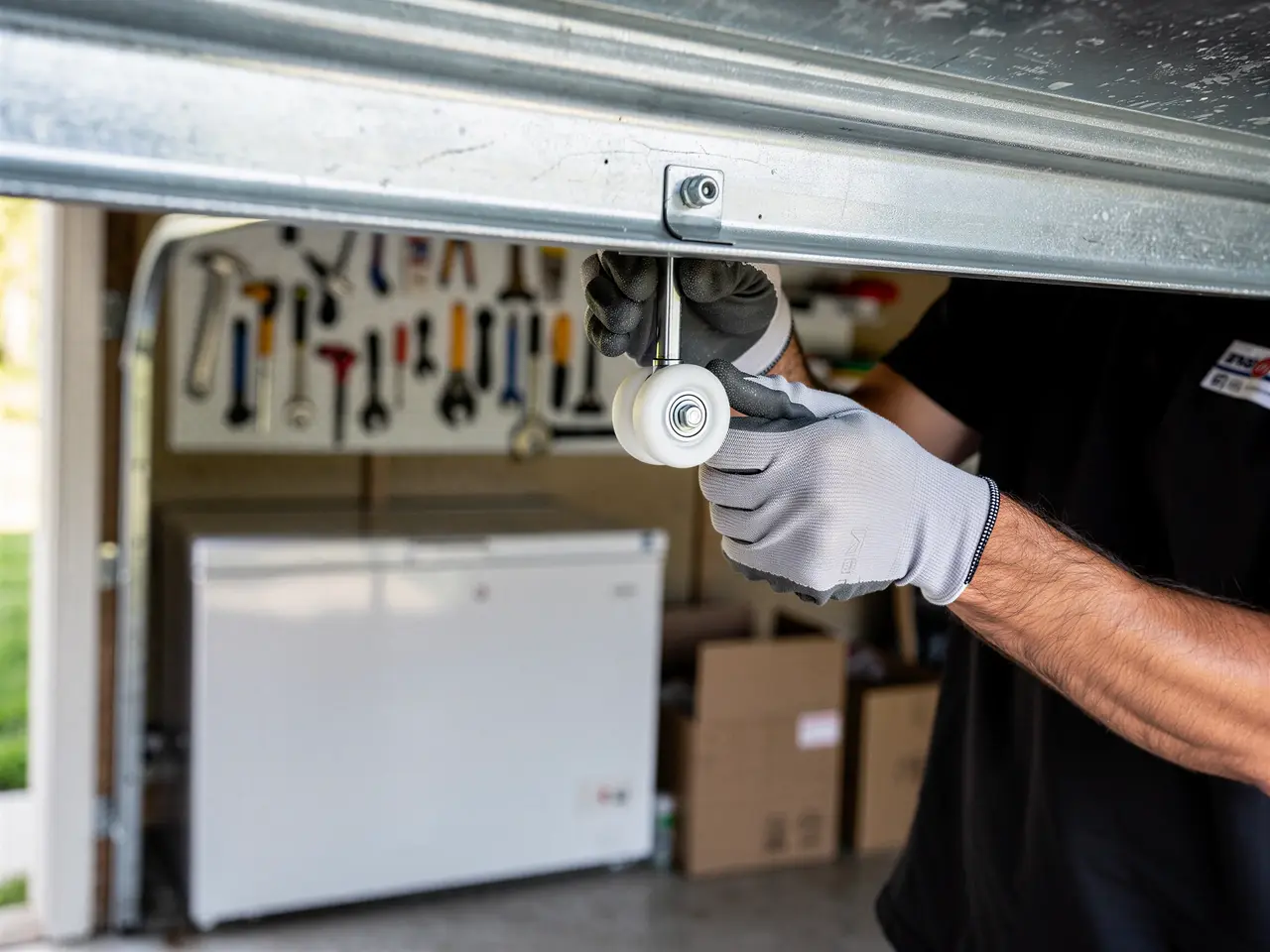
Most houses in Montgomery went up around 1993, well after the service area's overall median of 1968. That matters for rollers because a door from the early-to-mid '90s almost always shipped with factory 2-inch track and ten-ball stem rollers - steel, unsealed bearing, built to a spec that was standard for sectional doors that decade. The truck carries that roller in both 7-inch and 4-inch stem lengths, plus the nylon upgrade in the same sizes for owners who want quieter travel. What it doesn't carry is every oddball roller stem length from the handful of older doors scattered through the broader service area - those sometimes mean a special order and a second trip. On a 1993 door, that's rarely the problem; the stock sizes cover nearly everything we see on this end of the territory.
We also carry the sealed-bearing roller, which costs more up front but doesn't need the periodic grease that stem-bearing steel rollers do. On newer stock like Montgomery's, where the track and drum are usually still true, swapping to sealed bearings is often a straightforward upgrade rather than a repair forced by damage.
How Long You Are Without the Door
A roller swap on a door from this era is usually a same-visit job - the door comes apart section by section, old rollers out, new ones in, and it goes back together without pulling the whole panel assembly. That's different from a door where the track itself is bent or the panel has rusted around the roller bracket, which is more common on the area's older 1960s stock than on something built in 1993.
We travel from Trenton, about 15 miles out to this part of the territory, so the job gets scheduled rather than handled as a walk-up. We're not going to promise a response window here - that's not something we can back up for a stop this far from the shop. What we can say is that once the truck is on site, a roller job on sound 1990s hardware doesn't usually stretch into a second visit.
Where This Job Goes Sideways
The job gets more expensive when the rollers aren't the only thing worn. On a door built in 1993, thirty-plus years of travel can groove the track at the points where the roller rides hardest, even if the roller itself still looks serviceable. New rollers in a grooved track just repeat the noise and the binding within a year.
The other complication is the drum and cable setup. Doors from this build era commonly paired with torsion springs rather than the extension springs common on much older stock, and a roller job on a torsion system means the door has to come down safely before anyone touches a bracket. We check spring condition before we start, because replacing rollers on a door with a spring near the end of its life just means a second call soon after.
Honest limitation: if the track is bent badly enough to need straightening or replacement, that's a bigger job than a roller swap, and we'll say so rather than force new rollers into a track that won't hold them straight.
Why This Fails Locally
This area sits in a severe cold climate band, and steel stem rollers without sealed bearings stiffen up in a hard freeze. On a door from the 1990s that's never had the bearing greased, that stiffness shows up as a roller that doesn't turn freely - it skids instead, wearing a flat spot into one side. Repeat freeze-thaw cycles over enough winters and that flat spot turns into the grinding you hear on cold mornings.
Montgomery's housing sits at the newer end of the area's 1938-to-2004 range, so the heavier-gauge doors and older galvanized rollers still found on 1940s and '50s stock elsewhere in the territory aren't what we're dealing with here. The failure pattern on a 1993 door is almost always bearing wear and track grooving, not the rust-through and sagging section seen on much older doors. With a median household income of $223,409 - more than double the service area's overall $107,431 - owners here more often ask for the sealed-bearing nylon roller as a preventive swap rather than waiting for the steel roller to fail outright.
How It Shows Up
The first sign is usually a single loud spot in the door's travel - not grinding the whole way up, just one section where it catches or bangs. That's a flat-spotted roller hitting the same groove in the track on every cycle. Left alone, it gets louder and starts pulling the door slightly off-square as it travels, which puts uneven load on the opener.
A second pattern specific to newer stock like this: the opener strains or reverses partway up, even though the spring itself is fine. That's often a stiff roller dragging rather than rolling, especially after a stretch of cold weather. Montgomery has roughly 8,368 households, a small slice of the 184,178 across the full service area, and on the doors we've looked at in this part of the territory the roller wear almost always traces back to the same two or three worn stem rollers rather than a full set gone bad at once - which is part of why a roller job here is usually narrower in scope than a full hardware replacement.
Frequently asked questions
How do I know if it's the rollers and not the opener?
If the noise or catch happens at the same spot in the door's travel every time, it's almost always a roller or the track, not the opener. An opener problem tends to show up as the whole door struggling evenly, not one specific point.
Do newer doors like the ones in Montgomery need rollers replaced as often as older ones?
Not usually. A door from the early '90s with sound track tends to wear two or three rollers unevenly rather than the whole set failing together, which is a smaller job than what we see on much older stock elsewhere in the area.
Is the nylon roller worth the extra cost?
It runs quieter and doesn't need periodic grease, which matters more in a severe cold climate where unsealed steel bearings stiffen up. It's not required, but on newer doors with good track, it's a reasonable upgrade rather than a repair.
Can you replace rollers without touching the springs?
On most jobs, yes. But if the door has a torsion spring, the door has to come down safely before we work on the bottom rollers near the bracket, so we check spring condition first rather than skip that step.
More garage door services in Montgomery
Book garage door service in Trenton
Call now or request a quote - tell us what the door is doing and where you are.