Trenton, NJ · Garage Door Service
Off-Track Garage Door Repair for Yardville's 1960s Doors
Yardville homes went up around 1965 with steel doors on short extension-spring track. When a door jumps that track, here's what it takes to get it running right again.
- Repairs & new doors
- Springs & openers
- Serving 7 nearby communities
Doing It Yourself
A door that's hopped its track in a Yardville house built around 1965 is usually a single-layer steel panel door, 16 feet wide for a two-car opening, hung on track that was never deep or heavy-duty to begin with. These were builder-grade installs, meant to be light and cheap to run on extension springs rather than torsion bars. That matters because the rollers are smaller, the track brackets are thinner sheet metal, and fifty-plus years of use has usually stretched the mounting holes.
You can shove the door back onto the track with a pry bar and a shoulder, and plenty of homeowners do. The door will often roll again. What it won't do is stay aligned, because the bracket that let it jump in the first place is still bent or loose. Pushing a panel back into a warped track can also pop a cable off its drum, and if that cable is still under spring tension, that's a hand injury, not a repair job.
If the door came off because a cable snapped or a spring let go, do not touch it. Extension springs on these older setups don't always have containment cables, and a loaded spring under a hand is not worth saving a service call.
How Long You Are Without the Door
Once a door is off its track, you don't use it until someone resets it, full stop - a garage door that's cocked on one side is not safer half-closed. The truck comes from Trenton, about 6 miles out, so there's travel time baked into any call, but the repair itself on a straightforward off-track job is usually finished the same visit.
What stretches the timeline is the track and bracket hardware underneath it. On a house from the mid-1960s, the track gauge and roller stem sizes aren't always what's sold off the shelf today, and if a bracket is torn clean off the jamb rather than just bent, that's wood that may need backing before the new bracket goes in. That's not a five-minute fix, and it's the honest limitation here: a bent bracket gets straightened or swapped same-day, but a jamb that's split or rotted from age needs more than a bracket.
Why This Fails Locally
Yardville's housing stock centers on 1965, right in the middle of the 1938-2004 range across this part of the service area, and that era of construction used lighter track hardware than anything built since. Combine that with a COLD severe climate band and you get a specific failure pattern: the steel track brackets expand and contract through freeze-thaw cycles every winter, and the lag screws holding them to the jamb work loose a little more each year.
A loose bracket lets the track flex sideways under load. The door runs fine ninety-five times and on the ninety-sixth, a roller rides up and over the edge of the track instead of staying inside it. This isn't a defect in the door - it's fifty-plus winters of expansion and contraction doing exactly what cold climates do to fastened steel. Newer subdivisions with heavier gauge track and torsion hardware see this far less often than a neighborhood built when Yardville's housing stock was going up.
How It Shows Up
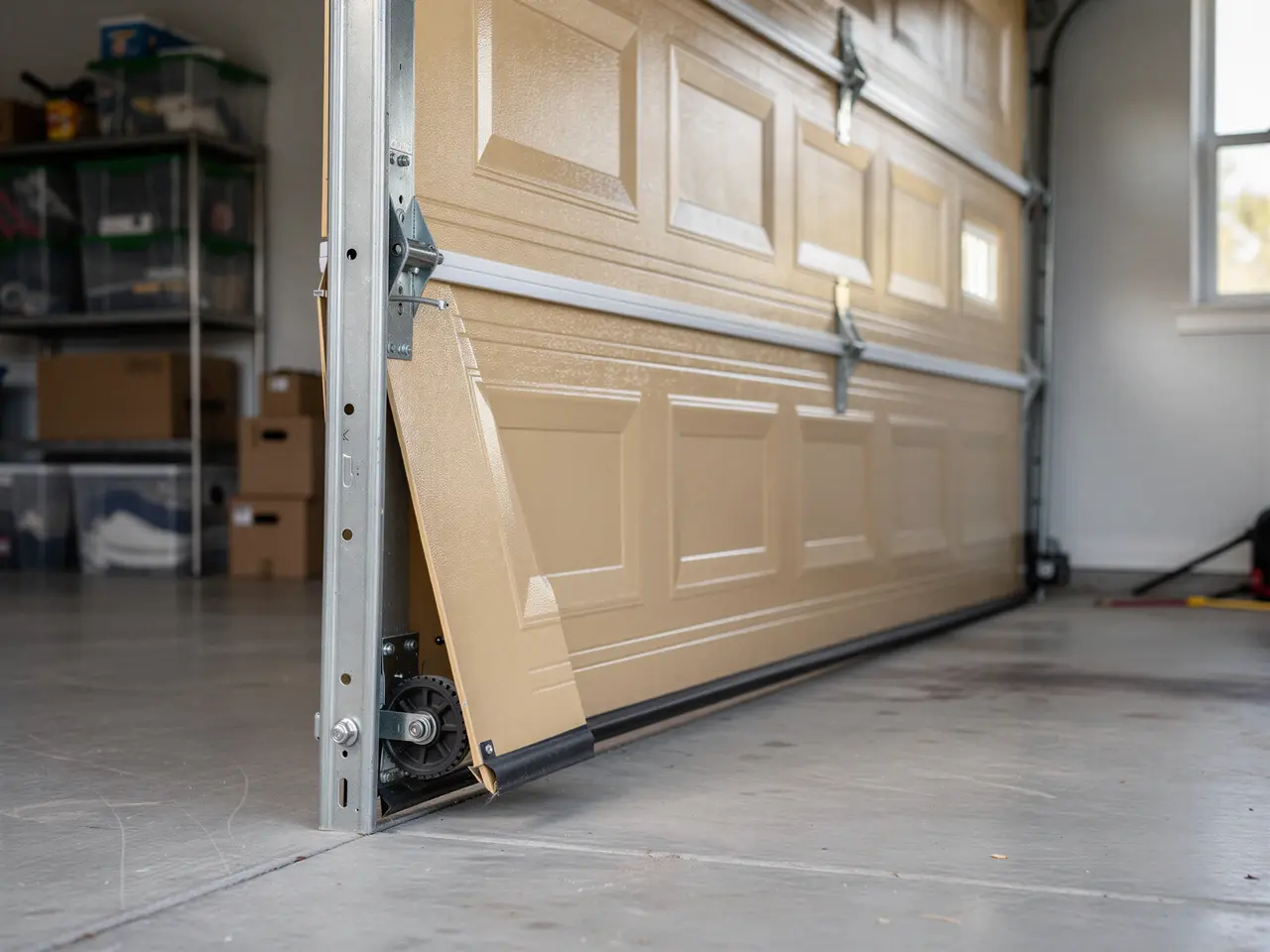
Most calls start the same way: the door stopped halfway, usually on the way down, and now it's sitting crooked in the opening with one bottom corner lower than the other. Sometimes there's a loud bang first - that's the roller letting go of the track, not the opener failing. Other times it's quieter, a slow leaning that's been building for weeks and finally gave out.
On these older Yardville doors, you'll often see the track pulled away from the wall on one side, with the bracket still attached but the screws backed halfway out of the jamb. If a cable snapped loose at the same time, the door may be sitting at a visible slant, heavier on one side. Either way, don't force the opener. Running the motor against a door that's off-track strains the opener and can bend the track further.
What Is on the Truck
For a 1965-era door on extension-spring track, the truck carries replacement roller brackets in a couple of gauges, extension spring sets sized for a 16-foot double door, and track sections long enough to splice in a damaged run without replacing the whole rail. Rollers come in both the smaller stem size common on older installs and the standard size used today, since not every Yardville garage has been upgraded.
What's not always on the truck is a custom-length track for a non-standard opening or a specialty bracket for a jamb that's been patched or rebuilt differently than the original framing. On a street where households built in the same era tend to share the same hardware, that's rarely an issue - but it does come up on houses that have had other work done to the opening over the decades.
Frequently asked questions
Why does my garage door keep jumping the track in Yardville but my neighbor's doesn't?
It usually comes down to how loose the track brackets have gotten. Houses in this area went up around 1965 with similar hardware, but one garage might get more sun and temperature swing on the bracket wall, or the screws were driven into a softer spot in the jamb. Same era, same parts, different wear.
Can I just push the door back onto the track myself?
You can, and the door will often roll again, but if the bracket that let it jump is still bent or the mounting screws are loose, it'll come off again. If a cable or spring let go at the same time, leave it - a loaded extension spring under a hand is a real injury risk, not a job to rush.
How far out is the truck coming for a Yardville call?
The truck runs out of Trenton, about 6 miles from Yardville. There's no local branch here, so factor in some drive time, but the off-track repair itself is typically done in the same visit once the truck arrives.
Will the repair match my existing track and rollers?
On most 1960s-era doors here, yes - the truck stocks the smaller roller stem size and track gauge common to that build period, plus the standard modern size for houses that have had upgrades. A non-standard opening or a reframed jamb can need a special-order part.
Book garage door service in Trenton
Call now or request a quote - tell us what the door is doing and where you are.