Trenton, NJ · Garage Door Service
Opener Repair for Yardville's 1960s Housing Stock
Yardville's housing dates mostly to the mid-1960s, which means chain-drive openers and aging hardware. We diagnose and fix what that era left behind.
- Repairs & new doors
- Springs & openers
- Serving 7 nearby communities
Doing It Yourself
Yardville's median house went up around 1965, right in the middle of the 1938-2004 build window that covers most of this part of the county, and squarely in the 1960s-70s stretch that produced most of the housing here. That matters for openers because a lot of those houses still have original or first-replacement units behind them - chain-drive, modest horsepower, simple logic boards.
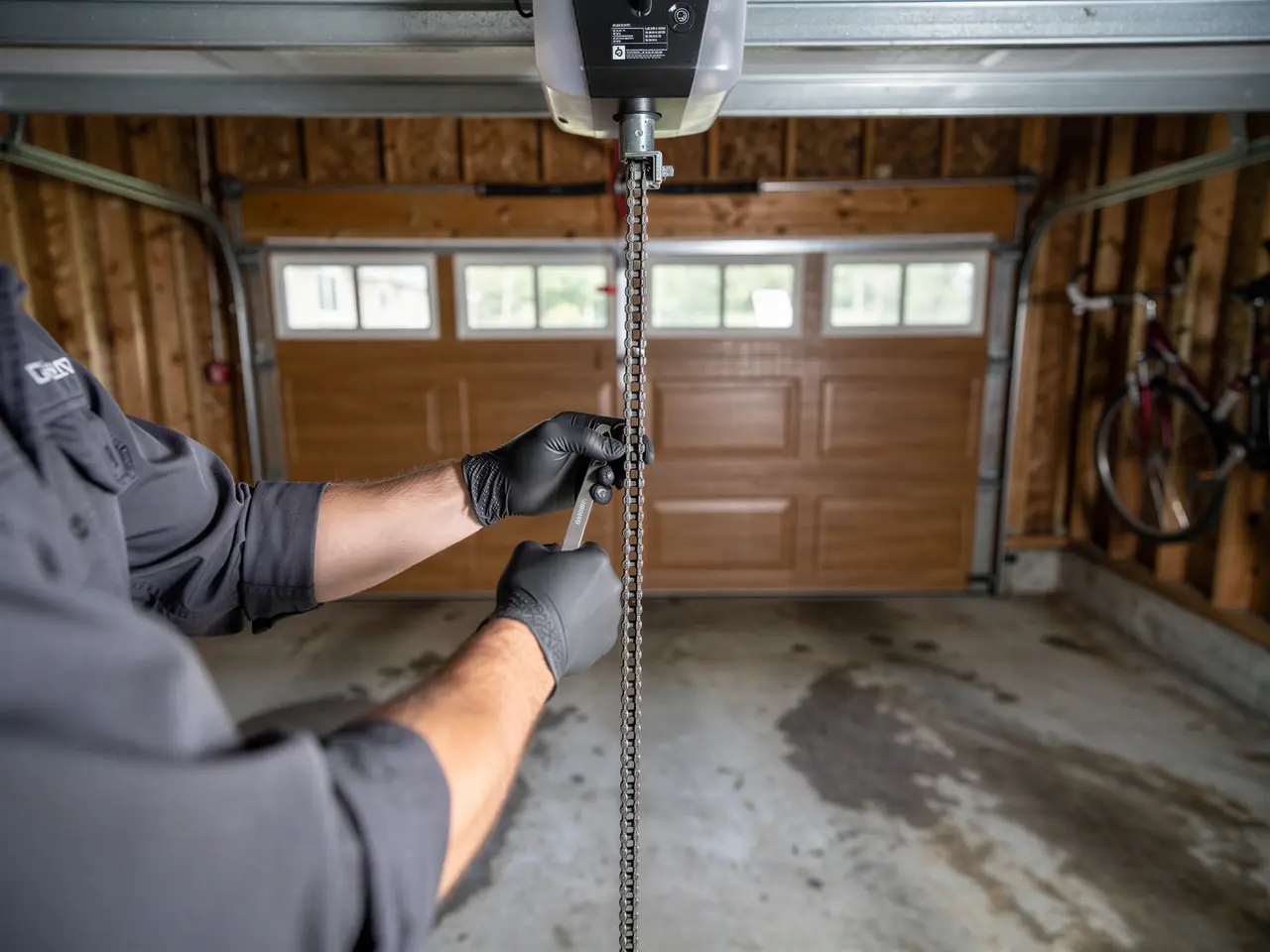
Some of what goes wrong is yours to fix. If the opener hums but the door won't move, check that the carriage hasn't disengaged from the rail - a dangling red cord usually means someone pulled the manual release and never reset it. Dead remote, no light on the wall unit: check the breaker before you call anyone. Photo eye sensors a few inches off the floor, pointed at each other, can get knocked out of alignment by a bike or a broom handle; a flashlight test tells you fast if one's blinking.
What isn't yours to fix: anything involving the torsion spring, the high-voltage side of the opener, or a logic board you can't identify. Here's the honest part - some of these older units use boards that haven't been made in years, and tracking down an exact replacement part can take longer than most owners want to wait. At that point, swapping the opener costs less in time and money than chasing a part for a 1960s-era motor. We'll tell you when that's the call instead of running up a bill trying to save it.
How Long You Are Without the Door
We run this out of Trenton, and Yardville sits about 6 miles out, which keeps the trip short but doesn't change the fact that we're not stationed in town. That distance mostly affects how we stack the day's calls, not whether we show up - a 6-mile hop fits easily between other jobs in the service area without forcing you to the back of the line.
What actually extends the time you're stuck is parts, not travel. If your opener is a common current model, we carry the logic boards, sensors, and drive components to finish most calls in one visit. If it's an older chain-drive unit original to a mid-1960s build, we may need to confirm a part number before the truck rolls, which can mean a return trip.
We don't promise a same-day window here, because we're not making that call without knowing what's actually wrong with your opener first. A dead capacitor is a same-visit fix. A cracked gear housing on a unit nobody's made parts for since the 1980s is a different conversation, and we'd rather have that conversation honestly than guess at a timeline over the phone.
Why This Fails Locally
The climate band here is rated cold and severe, and that interacts badly with openers built for an earlier era of hardware. Grease inside a decades-old drive gear housing thickens in winter cold, and a motor that's already working against stiff grease and a slightly out-of-balance door will stall, trip its overload protection, or burn out a capacitor faster than a newer unit would.
Houses built in the 1960s window that makes up most of Yardville's stock (and most of the surrounding 57 named areas) commonly got chain-drive openers with steel chains running on plastic sprockets. Plastic ages. Decades of thermal cycling - hot garages in summer, cold ones through winter - makes those sprockets brittle, and a cracked sprocket under chain tension is one of the more common failures we see on original-to-the-house units.
The other piece is simpler: circuit boards from that generation weren't built with today's surge protection standards. A cold-season power blip that a modern opener shrugs off can take out an old board entirely. None of this is damage you can see from the garage floor - it shows up as the opener just stopping, with no obvious cause.
How It Shows Up
Most calls start the same way: the opener runs, you hear the motor, and the door either doesn't move or moves partway and reverses. On older chain-drive units, that's often a stripped or cracked sprocket - the chain is turning but not pulling the carriage along the rail. On newer belt or screw-drive openers, the same symptom usually points to a worn drive gear or a slipping belt.
Sometimes there's no motor sound at all. That's either a dead capacitor, a tripped circuit, or - on the older units - a logic board that's finally given out after years of cold-season power fluctuations. A remote that worked yesterday and doesn't today, with the wall button still functioning, usually means a dead battery or a knocked-loose antenna wire, not a board failure.
The door reversing immediately when it's about to close almost always traces back to the photo eye sensors, especially in winter when condensation or frost can fog the lenses enough to throw off the beam. We check that first on any reversing complaint because it's the cheapest fix and the most common cause, well before we start pulling the opener cover.
What Is on the Truck
Given how much of Yardville's housing sits in that mid-1960s window, we carry parts aimed at both eras: current logic boards and photo eye kits for newer belt and screw-drive units, and chain, sprockets, and capacitors sized for the older chain-drive openers still running in a lot of these houses. We also carry a stock of remotes and wall controls, since those fail on their own schedule regardless of the opener's age.
What we don't carry is every obsolete board for every discontinued model. If your opener is old enough that the manufacturer stopped making parts for it, we'll check what's available before committing you to a repair bill, and we'll say plainly when replacement is the better option. Given the income levels typical in this area, most owners we've talked with prefer a straight answer on that trade-off over a patched repair that might not outlast the season.
We also keep weatherproofing supplies for opener housings - foam seals and cover gaskets - since the cold-and-severe climate rating here means moisture and temperature swings do more damage to exposed components than age alone usually would.
Frequently asked questions
Is my opener too old to repair?
It depends on the part, not just the age. If it's a chain-drive unit original to a 1960s-era Yardville house, the drive components are often still available, but logic boards for some old models are not. We check part availability before quoting repair versus replacement so you're not guessing.
Why does my opener struggle more in winter?
Cold thickens the grease inside the drive mechanism, and a motor already working against a slightly unbalanced door has to push harder through that stiffness. In a cold-and-severe climate zone like this one, that extra strain is what burns out capacitors and strips aging gears.
Do you carry parts for older chain-drive openers?
Yes - chain, sprockets, and capacitors sized for the chain-drive units common in houses built around the 1960s are stocked on the truck. Logic boards for some discontinued models aren't always available, and we'll tell you straight if that's the case before starting work.
How far out is Yardville from your shop?
About 6 miles from Trenton. We don't run a branch in Yardville itself, so scheduling depends on the day's route, not a local response time.
More garage door services in Yardville
Book garage door service in Trenton
Call now or request a quote - tell us what the door is doing and where you are.